A robot sent to another world may find a promising chemical signal and still fail to prove that life made it. The hard part is collecting the right material, keeping it clean, and showing why the result rules out nonliving causes.
- Cameras can show rocks, ice, and surface changes, but images alone cannot confirm life.
- Drills and sample tools let robots test material below the surface.
- A life claim needs several lines of evidence, not one unusual reading.
The search starts with a good site
A robot cannot test every metre of a planet or moon. Mission teams first look for places where liquid water may have existed, where organic compounds could survive, or where material from below the surface reaches the top.
That choice shapes the whole search. A rover with a strong laboratory may learn little if it stops in a dry, altered patch of ground. A less capable robot at a site with preserved material could return more useful results.
The surface can also mislead the robot. Radiation, dust, heat, and chemical reactions can change organic material after it reaches the ground. A sample that looks empty may have lost the evidence the robot was built to find.
What the robot needs to test
A camera gives the team a map and helps place rocks in context.
Spectrometers then check how material absorbs or reflects light, which can point to minerals and carbon-based compounds. Those readings narrow the search, but they do not identify living cells by themselves.
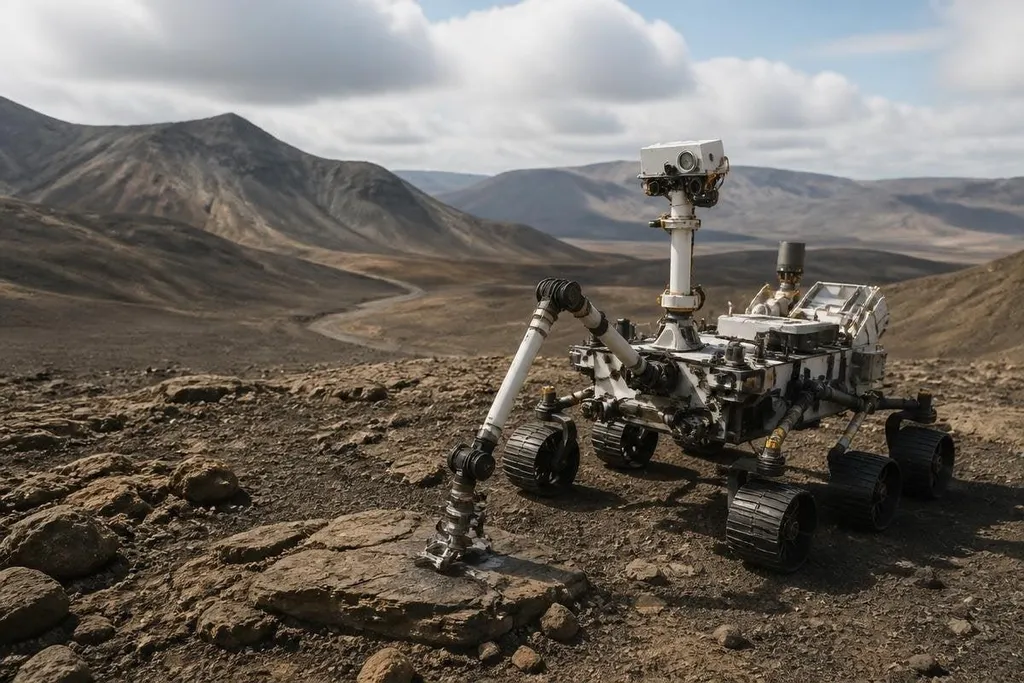
The next step is contact with the material. A drill can reach layers protected from surface damage. A scoop can gather loose soil. A robotic arm can press a sensor against a rock or move a sample into an internal chamber, where instruments can work with less interference.
The most useful design combines several tools. One sensor may find a chemical pattern; another can check the mineral setting around it. That link matters because some nonliving reactions can create compounds that resemble signs of biology.
For professional readers tracking autonomous systems, Robot24.com’s space robotics reporting can connect a robot’s sensor design with the mission task and test record. That context matters here because a life-detection claim depends on what the machine measured, where it worked, and what scientists could verify.
The proof problem
Finding an organic compound is not the same as finding life. Carbon-based material can form through chemistry that needs no biology, and a robot may lack the instruments needed to separate those causes on site.
A stronger case would connect several findings: a chemical pattern, a physical structure, and a setting that could support the process that made them. The samples would also need to survive the trip through the robot without contamination from Earth.
That last point is easy to overlook. A tiny amount of material from a drill bit, seal, or handling tool could confuse the result. Planetary protection rules exist because a life detector must show where its signal came from before anyone can trust it.
The limits of remote science
Robots work far from repair crews. A command may take time to reach the machine, and a difficult sample can force the team to choose between risk and useful data. The robot may also have to stop when dust covers a sensor or a wheel loses contact with the ground.
Autonomy helps with routine choices. Software can spot a rock that matches a target pattern, plan a short drive, or reject a route that looks unsafe. It still needs clear limits, since a false match can send the robot away from the best sample.
I’d trust a cautious result that names three possible causes more than a bold life claim built on one reading.
A practical test for future missions
Before treating a discovery as evidence of life, check these points:
- Site choice: Does the location preserve material that could contain biological signals?
- Sample depth: Did the robot test below the surface, or only inspect exposed dust?
- Instrument overlap: Did separate tools support the same result?
- Contamination control: Can the team show that Earth material did not cause the signal?
- Alternative chemistry: Did the analysis test nonliving causes?
- Follow-up access: Can another robot or a returned sample check the finding?
The robots searching for life beyond Earth will get better as drills, sensors, autonomy, and sample handling improve. The answer may still depend on a later mission that can bring the material home, where larger instruments and human scientists can test it from many angles.